
Behind the Counter
Beyond the Buzz: What Restaurant Operators Really Want From AI
June 2, 2026
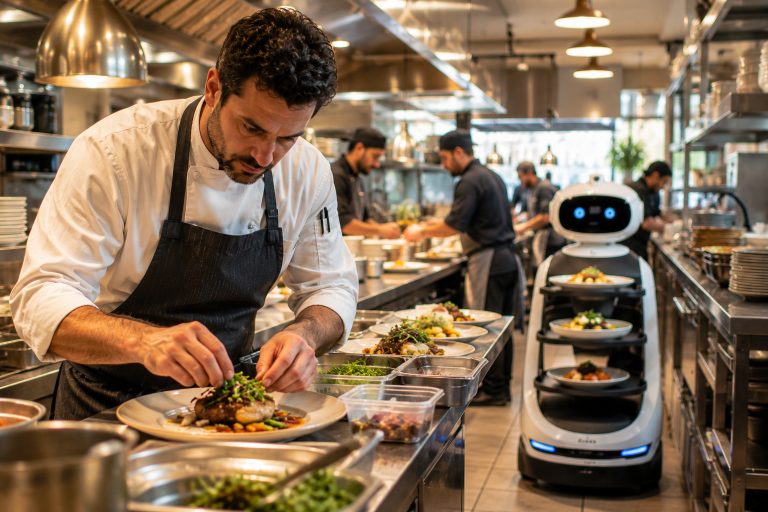
Operators are moving past AI hype and asking whether automation can prove value through profit, retention, efficiency, and guest experience.
Overview
Artificial intelligence was impossible to miss at the 2026 National Restaurant Association Show. Nearly every booth had an AI story to tell.
But as AI becomes harder to avoid, restaurant operators are becoming harder to impress.
That’s why the conversation at this year’s NRA Show felt different.
The excitement hasn’t disappeared. If anything, AI remains one of the most talked-about topics in restaurant technology. Yet many operators are entering a new phase of the conversation.
The novelty phase is fading. The evaluation phase is beginning.
And ironically, the future of restaurant AI may not be found in the spotlight. It may be found behind the curtain.
After all, operators rarely think about the technologies that quietly power their businesses every day. Wi-Fi, POS systems, payment processors, online ordering tools, and delivery platforms like Sauce have become part of the operational infrastructure restaurants simply expect to work.
Nobody chooses a POS system because it’s connected to the internet. Nobody evaluates a delivery platform based on the routing algorithms working behind the scenes. They care whether orders arrive, customers return, and operations run smoothly.
Artificial intelligence may be headed in the same direction.
The most valuable applications may not be the most visible. Instead, they may quietly optimize routes, forecast demand, detect fraud, improve customer retention, and help restaurants operate more efficiently without drawing attention to themselves.
That reality helps explain why savvy restaurant operators are asking different questions about AI.
They’re not asking whether a platform uses artificial intelligence.
They’re asking:
Will it deliver measurable value?
Will it save labor?
Will it increase sales?
Will it improve guest experience?
Will it solve a meaningful operational problem?
And perhaps most importantly, is it any better than what they’re already using?
In that sense, the ultimate success of AI may be the moment everyone stops talking about it.
Operators Becoming ROI Detectives
Not long ago, technology sales pitches often centered around convenience.
The software would save time. The platform would automate tasks. Technology would make life easier.
Today, many operators are asking tougher questions.
What aspects of the restaurant business will be most impacted by Artificial Intelligence? How much time will it save? How much profit will it generate?
In an industry where margins remain under constant pressure, vague efficiency claims are becoming less persuasive. Restaurant owners increasingly want to understand how technology affects labor costs, customer retention, order frequency, food waste, average ticket size, and overall profitability.
The conversation has shifted from activity to outcomes.
A tool that reduces scheduling time by 30 minutes per week may sound impressive. But operators are more interested in understanding whether that saved time translates into lower labor costs, better staffing decisions, or improved guest experiences.
“Saves time” is becoming one of the least persuasive claims in restaurant technology because operators increasingly want to know what that saved time is actually worth.
The Rise of AI Slop
Just as consumers have learned to recognize generic AI-generated content online, restaurant operators are becoming better at spotting AI features that exist primarily for marketing purposes.
The internet is currently experiencing a flood of AI-generated content. Blogs, social media posts, product descriptions, emails, and videos are being created at unprecedented speed, often with varying degrees of quality. Many observers have begun referring to the lowest-quality examples as “AI slop.”
Restaurant technology may be entering a similar phase.
Suddenly, AI chatbots appear inside platforms where they may not be necessary. Marketing tools generate content that sounds generic. Predictive systems make recommendations with little transparency into how those recommendations were produced. Dashboards become crowded with AI-powered features that operators rarely use.
The issue isn’t that these tools are inherently bad.
The issue is that not every AI feature solves a meaningful problem.
Some simply create the appearance of innovation.
As operators become more familiar with artificial intelligence, they are growing better at distinguishing between technology that creates measurable value and technology that exists primarily because competitors have similar features.
Quiet AI May Be Winning
Ironically, the most valuable AI in restaurants may be the AI that receives the least attention.
Rather than serving as a flashy front-facing feature, many of the strongest applications operate quietly behind the scenes. Delivery routing, inventory forecasting, fraud detection, customer segmentation, review monitoring, and menu optimization are all areas where artificial intelligence can deliver meaningful operational improvements without becoming the center of attention.
Most operators don’t particularly care whether an algorithm is involved.
They care whether orders arrive faster. They care whether food waste declines. They care whether customers return more often and whether revenue grows.
That reality may explain why so-called “quiet AI” is gaining traction.
The technology works in the background, solving problems without requiring restaurant owners to fundamentally change how they operate. Customers may never know it’s there. Operators may rarely think about it. Yet it still creates value.
Platforms like Sauce illustrate this shift. Restaurant owners aren’t evaluating delivery platforms based on how much AI they contain. They’re evaluating them based on whether they help drive direct orders, improve customer retention, strengthen delivery operations, and support long-term revenue growth.
The most successful restaurant AI may be the one customers never notice, and operators rarely think about.
The Future of Delivery
Delivery may offer one of the clearest examples of where restaurant AI is headed.
While headlines often focus on robots, autonomous vehicles, and futuristic ordering experiences, many of the most meaningful innovations are likely to happen behind the scenes.
Artificial intelligence is increasingly being used to optimize delivery routes, predict demand, improve dispatch decisions, identify fraud, personalize marketing, and help restaurants better understand customer behavior.
In many cases, neither the restaurant nor the customer sees the technology at work. They simply experience faster deliveries, more accurate arrival times, improved order accuracy, and more relevant promotions.
This may represent the future of restaurant AI as a whole. The technology becomes less visible while its impact becomes more measurable.
Five years from now, operators may spend less time asking whether a platform uses AI and more time evaluating whether it helps drive repeat orders, improve retention, increase efficiency, and strengthen profitability.
The most successful delivery technologies may not be the ones that talk the most about artificial intelligence. They may be the ones that quietly use it to solve operational problems better than anyone else.
Savvy Restaurants Running Experiments
Another reason restaurant owners are becoming more skeptical of AI marketing claims is simple. Many are already using AI themselves.
Operators are experimenting with ChatGPT, Gemini, Claude, Canva AI, scheduling assistants, content generators, and a growing list of business productivity tools. Some are using AI to draft marketing content. Others are exploring menu development, staff communications, customer service responses, or operational planning.
This firsthand experience is creating a more informed buyer.
Restaurant owners now understand that AI can be remarkably useful in certain situations while also producing inconsistent, inaccurate, or generic results in others.
The result is a healthier level of skepticism.
Instead of viewing artificial intelligence as either revolutionary or worthless, operators are increasingly evaluating it as a tool. They understand its strengths. They understand its limitations. And because they have direct experience with the technology, they are becoming significantly harder to impress with broad marketing promises.
Forecast: What Will Restaurant AI Look Like in Five Years?
For all of the discussion surrounding artificial intelligence, there remains considerable uncertainty about where the technology ultimately leads.
Will AI become invisible infrastructure that quietly powers software behind the scenes?
Will today’s standalone AI tools survive as independent products?
Or will artificial intelligence simply become another standard software capability, embedded into nearly every platform operators use?
History suggests the latter may be possible.
Businesses no longer advertise that they use internet-powered software because internet connectivity eventually became the default expectation. Artificial intelligence may follow a similar path.
Five years from now, many restaurant operators may have stopped talking about AI altogether. The most successful tools won’t be marketed as AI products. They’ll simply be restaurant technologies that happen to use AI behind the scenes.
The technology itself may matter far less than the results it produces.
Take Away
Restaurants are not rejecting artificial intelligence. If anything, they are becoming more sophisticated about it.
The novelty phase appears to be fading. The evaluation phase is beginning.
Operators increasingly want proof instead of promises. They want measurable outcomes instead of theoretical efficiencies. They want technologies that solve specific operational challenges rather than products that simply showcase the latest trend.
That shift may ultimately reshape the restaurant technology landscape.
The winners are unlikely to be the companies making the biggest AI claims. More likely, they will be the companies that consistently help operators improve revenue, efficiency, customer retention, and day-to-day operations.
For restaurants, the question is no longer whether AI matters.
The question is whether a particular AI tool delivers enough real-world value to justify the cost, learning curve, and operational change that comes with adopting it.
That shift may be one of the most important developments in restaurant technology today.
Because in an industry built on thin margins and constant pressure, practical results will almost always outlast hype.