
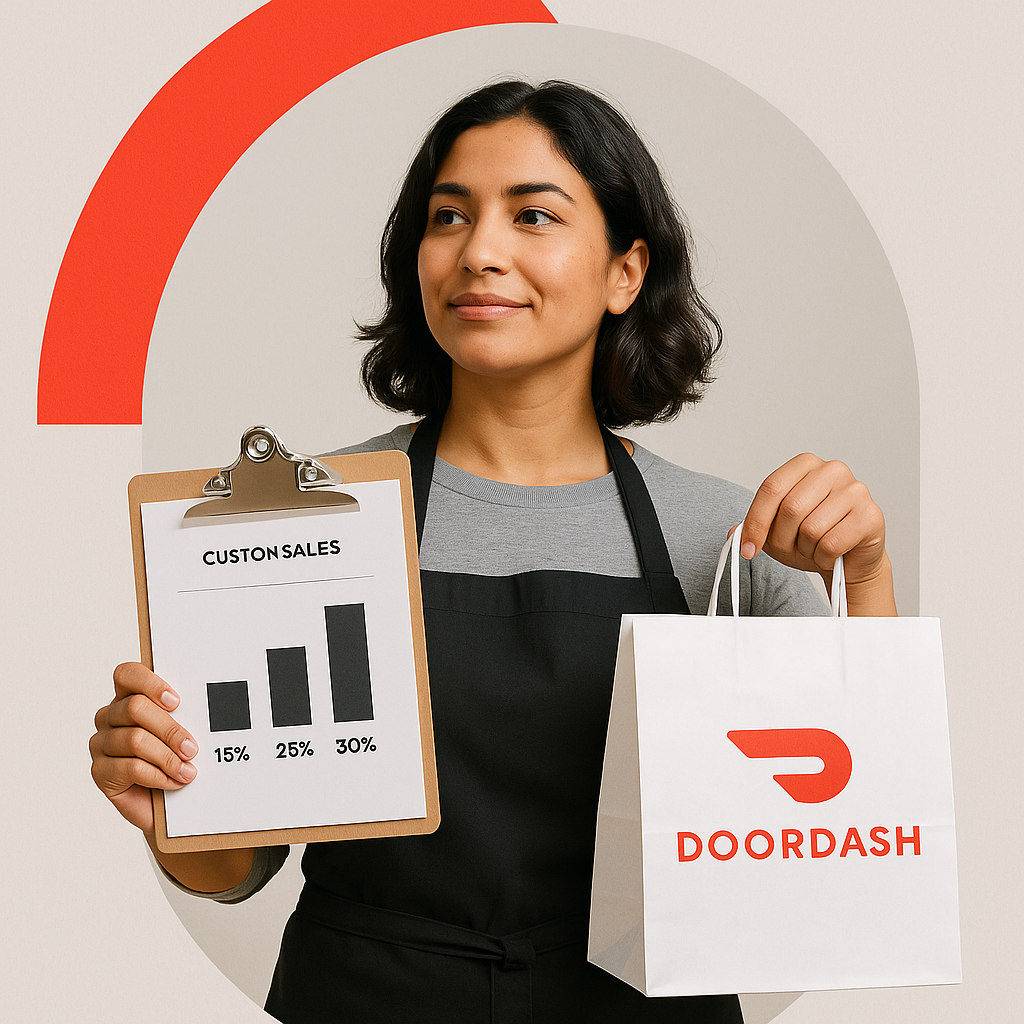
If you're a restaurant owner trying to understand how much does DoorDash charge restaurants, the answer depends on your plan, order volume, and which DoorDash product you're using. Commission rates range from 15% to 30% per order, and these fees can quietly erode margins at scale. As of 2026, with delivery continuing to dominate off-premise dining, knowing exactly what you're paying, and what alternatives exist, has never been more important.
| Plan | Commission Rate | Best For |
|---|---|---|
| Basic | 15% | Basic marketplace visibility |
| Plus | 25% | Expanded reach and DashPass access |
| Premier | 30% | Full marketing support and growth tools |
| Drive On-Demand | Flat fee per order | Restaurants using their own ordering channel |
DoorDash Commission Plans: What Each Tier Actually Costs
DoorDash structures its restaurant fees around three Marketplace tiers, each bundling marketing, logistics, and technology into a single commission rate.
- Basic (15%): Foundational access to the DoorDash platform with standard marketplace visibility.
- Plus (25%): Unlocks DashPass eligibility, exposing your restaurant to DoorDash's subscription customers.
- Premier (30%): Broadest marketing support, including priority placement and growth guarantees in some markets.
These commissions apply to every order's subtotal. On a $50 order, you're handing over $7.50 on Basic, $12.50 on Plus, or $15.00 on Premier. For high-volume restaurants, the cumulative cost is significant. For a deeper comparison, see this overview of delivery app commission rates for restaurants.
What Restaurant Owners Say
Restaurant owners using DoorDash report mixed experiences with the fee structure:
What owners appreciate:
- Access to a large customer base they wouldn't reach otherwise
- Fully managed delivery logistics and driver network
- Built-in customer support for order issues and refunds
Common complaints:
- Commission rates of 25, 30% make profitability difficult on thin-margin items
- Restaurants don't own customer data, DoorDash retains emails and contact info
- Pickup orders still incur fees, which many owners find surprising
How Much Does DoorDash Charge Restaurants Per Day?
There is no fixed daily fee, your daily cost is entirely driven by order volume and average order value. For a restaurant processing 10 orders per day at an average of $50 each:
- Basic (15%): ~$75/day → ~$2,250/month
- Plus (25%): ~$125/day → ~$3,750/month
- Premier (30%): ~$150/day → ~$4,500/month
Does DoorDash Charge Restaurants for Pickup Orders?
Yes, commissions apply to pickup orders, not just delivery. Pickup orders are typically charged at a lower rate, but they are not free. Some independent sources note an additional pickup fee of around 6% per order on top of the base commission. This is a detail many restaurant owners overlook when calculating their true platform cost. If you rely on DoorDash primarily for pickup volume, factor this into your margin analysis.
What DoorDash Fees Actually Cover
DoorDash positions its commission as an all-in bundled service rather than a simple transaction fee. Across its plans, fees cover:
- Marketing and visibility: Marketplace placement, promotional campaigns, and DashPass subscriber access depending on your tier.
- Dasher network: Recruiting, paying, and insuring delivery drivers, including background checks and support.
- Customer service: DoorDash manages customer-facing support for order issues, refunds, and complaints.
- Technology and payment processing: The ordering platform, app infrastructure, and payment reconciliation are all included.
For restaurants lacking their own delivery infrastructure or marketing budget, this bundled model has genuine value. The question is whether percentage-based pricing remains cost-effective as order volume grows.
Is There a Way for Restaurants to Avoid or Reduce DoorDash Fees?
Two practical strategies stand out:
- Shift volume to direct ordering: Build your own branded ordering channel (website or app) where no marketplace commission applies. Encourage adoption through loyalty programs, exclusive promotions, or simply making your direct channel more visible than your DoorDash listing.
- Use a flat-fee delivery platform: Connect your direct orders to a driver network, similar to DoorDash's Drive On-Demand product, so you retain logistics benefits without percentage-based fees.
DoorDash itself offers Drive On-Demand for restaurants with existing ordering channels. This connects your direct orders to DoorDash's driver network for a flat fee per delivery rather than a percentage commission. You keep the customer relationship and pay a predictable logistics cost, though you lose marketplace visibility. For a detailed breakdown of tactics, this guide on how to reduce DoorDash fees covers the most effective approaches.
A Commission-Free Alternative: How Sauce Approaches Delivery
For restaurants looking to eliminate percentage-based commissions entirely, Sauce offers a fundamentally different model. Instead of charging 15, 30% per order, Sauce connects your direct online orders to a national network of delivery drivers with zero commission per transaction.
Key Differences from DoorDash
| Feature | DoorDash Marketplace | Sauce |
|---|---|---|
| Commission | 15, 30% per order | None (flat-fee model) |
| Customer data ownership | Retained by DoorDash | 100% owned by restaurant |
| Delivery logistics | DoorDash Dasher network | Multi-fleet driver network |
| Marketing tools | Marketplace placement | AI-powered retention tools |
Critically, Sauce gives restaurants full ownership of customer data, emails, phone numbers, order history, which DoorDash retains on its platform. Every order through DoorDash builds DoorDash's relationship with your customer, not yours.
What Sauce Users Are Saying
Restaurant owners using Sauce have highlighted the pricing advantage directly. One user noted: "much better pricing options than other 3rd party deliveries" and another described it as "a platform that makes it easy for our customers to place pickup and delivery orders at a much lower fee." Some users have mentioned a bumpy onboarding experience, but the consensus as of early 2026 is that the financial and operational benefits outweigh the initial setup friction. You can compare Sauce alongside other platforms in this delivery app commission rate comparison.
Understanding how much does DoorDash charge restaurants is ultimately about calculating what that percentage costs at your actual order volume and deciding whether marketplace exposure justifies the margin you're giving up. For some restaurants, DoorDash's bundled model works as a customer acquisition channel. For others, especially those with established customer bases, the math increasingly points toward direct ordering solutions that eliminate the commission entirely.
Frequently Asked Questions
How much does DoorDash charge restaurants per order?
DoorDash charges restaurants between 15% and 30% per order depending on the plan. The Basic plan costs 15%, Plus costs 25%, and Premier costs 30% of each order's subtotal.
Does DoorDash charge restaurants for pickup orders?
Yes, DoorDash charges commissions on pickup orders, not just delivery. Pickup orders are typically charged at a lower rate, but some sources note an additional pickup fee of around 6% per order on top of the base commission.
How much do DoorDash fees cost a restaurant per month?
For a restaurant processing 10 orders per day at $50 average, monthly DoorDash fees range from roughly $2,250 on the Basic plan to $4,500 on the Premier plan, before accounting for food costs, labor, or rent.
Can restaurants reduce or avoid DoorDash fees?
Yes. Restaurants can shift order volume to their own branded direct ordering channel, use DoorDash's Drive On-Demand for flat-fee delivery logistics, or switch to a commission-free platform like Sauce that connects direct orders to a driver network without percentage-based fees.
What do DoorDash's restaurant fees actually cover?
DoorDash fees bundle marketplace visibility and marketing, the Dasher delivery driver network, customer-facing support for order issues and refunds, and the technology platform including payment processing.